Showing posts with label Slaughter. Show all posts

Monday, 3 February 2014

Return to Taiji: My Experience Witnessing the Dolphin Hunt Drive and Slaughter in Taiji Japan, by Cynthia Fernandez

Cynthia Fernandez looking towards The Cove in Taiji, Japan
Return to Taiji: My Experience Witnessing the Dolphin Hunt Drive and Slaughter in Taiji Japan
by Cynthia Fernandez,
Volunteer Cove Guardian for Ric O'Barry's Dolphin Project
November 18th to December 1st, 2013

When I was planning my return to Taiji, I knew that by coming during November, I would see more hunting than the last time I was here. My last trip to Taiji was at the end of December and into early January. The hunters were on holiday until January 5th so I only witnessed six days of hunting. During those six days, I saw two at-sea captures of beautiful Pacific White-Sided dolphins, two “blue” days when no dolphins were captured and two days of slaughter, both days were Risso’s dolphins. Those six days are etched in my memory forever.

I thought I was prepared for my return to Taiji, knowing there would probably be about fourteen days of hunting during my stay. Knowing I would, most likely, witness many more slaughters. I know it’s been said before, but, it is so true, NOTHING prepares you for this place.


Haunting video by Cynthia Fernandez to tell the story of what she witnessed in Taiji


One species I had really hoped not to see in the Cove was pilot whales. Although each species is unique and I love them all, there’s something about the way the pilot whales huddle together and spy-hop to try to figure out where they are and what’s going on. I had seen many photos of it and had hoped NOT to witness it myself.

My very first day, my fellow Cove Monitors Tia and Johanna and I watched the killers go out to hunt. Hours later, we saw the dreaded drive formation. They seemed to be moving quite slowly. This pod had pulled the hunters far to the south and had given them a very good fight. However, as the drive formation grew closer, my heart sank when Tia said “They’ve got pilot whales!”


Pilot whales being driven in after long chase towards The Cove.
As the pod had given the killers such a good fight, it had taken many hours to drive them in and it was late by the time they were finally netted into the Cove. They were to be held overnight and slaughtered in the morning. As we drove away from Taiji, our hearts were heavy and the inside the car was silence as we were each lost in our own thoughts. A little later, as we were eating lunch together, we thought about our freedom, how we were free to eat, to go back to our hotel...wherever we pleased and how those poor pilot whales were stuck in that Cove with no food and no escape. It haunted us. We went back to the Cove to spend the evening hours with the pod. It was heartbreaking to see them all huddled together by the outer net, spy-hopping, confused, not aware of the horrors that awaited them. It was very difficult to sleep that night.

Pilot whales now exhausted after long ordeal of being chased
by dolphin hunters now netted into The Cove.
The next morning as we drove to Taiji, knowing what we were about to witness, again, there was silence. We arrived to see the pilot whales still in the Cove, spy-hopping and looking confused. The fishermen began to arrive. One sat in a skiff, right next to the pilot whales, just looking at them. The matriarch of the pod was huge and when she spy-hopped, her very large head looked right at her tormentor. I wonder what she was thinking. The dolphin killer looked back at her, I had to wonder if he had even a drop of compassion for these animals he was about to brutally slaughter. I’ll never know.

Juvenile pilot whales separated from their family
The pod was divided into two groups. The smaller juveniles were kept at the outer edge while the killers began to push the larger adults towards the tarps. It wasn’t easy as this family of pilot whales fought hard for their lives. There was a lot of screaming coming from the fishermen and a lot of splashing from the pilot whales as they struggled to survive. Divers were wrestling with the pilot whales to pull them under the tarps. Then, they went for the matriarch. Two divers, one on each side, were struggling to pull her under the tarps. A third diver came to help. After a long struggle, they finally succeeded and she disappeared from our view. What happened next was something I’ll NEVER forget. 

Divers manhandling and jumping on the Pilot whales backs
 forcing and pushing them into The Cove.

I suppose it was the moment they drove their killing tool through her blowhole, it was the loudest sound I’ve ever heard, it sounded like thunder shaking the Cove. The killers screamed and I’m sure they had to jump to get out of the way as we could hear her thrashing in the water for what seemed like an eternity. Eventually an eerie silence took over. Anyone who says that the killing is quick and humane hasn’t witnessed a slaughter. There was nothing quick nor humane about what had just occurred.

Pilot whales struggling to keep away from the killers

Frantic Pilot whales being pushed under tarps to their fate.
 
Pilot whales clearly frightened swimming in family members blood and
pushing up against the rocks trying to get away.
During the entire slaughter process, the juveniles kept creeping closer and spy-hopping, trying to see what was happening to their family members. It was heartbreaking to watch those shell-shocked juveniles watching the carcasses of their dead family members dragged by them as they huddled together for comfort. As the killers pulled the nets in, the juveniles were free to go but, of course, they wouldn’t leave. They swam slowly and cautiously towards the killing area as if trying to find their lost family members.

Pilot whales are known to be very close knit family groups,
here you see them huddled together in The Cove.
The killers, exhausted from their morning’s work, took a long break. Leaving the traumatized juveniles in the killing cove. The poor things huddled together, not knowing what to do without the leadership of the matriarch and the other adults. I knew the killers would have to return and drive them back to sea. They wouldn’t leave the place where they had last seen their family members on their own. I looked at that group of completely traumatized juveniles, too small for the killers to use their valuable quota on, and I hoped that one of them would step up and take the leadership role so this precious pod would survive. As I watched them being drive back out to sea, I could only hope they will survive and, if they do, I hope they never return to the shores of Taiji. 

 
******

My two weeks in Taiji were absolutely brutal. I witnessed the brutal and violent slaughter of the pilot whales. I watched the traumatized juveniles being driven back out to sea to face life on their own after watching their family members be brutally slaughtered. I think of them daily and hope they are somehow able to survive. I watched several slaughters of Risso’s dolphins. I’ll never forget the sadness I felt when looking at the pod before the slaughter began and seeing a mother with two tiny calves swimming right next to her. I’ll never lose that feeling of incredible anger and frustration as I watched the adult Risso’s be slaughtered and then the very young Risso’s calves along with a couple of juveniles be loaded into a skiff, driven out to sea and then callously dumped over the side of the boat like a bag of garbage. 
 
Risso dolphin caught in the net, trying to get away
Even the Blue days were difficult as I witnessed the removal of the dead bottlenose dolphin from the sea pen and visited the captive facilities here. The faces of those captive dolphins told a very sad, tragic story. I visited Dolphin Base and observed the “training” sessions. Watching those beautiful, incredibly intelligent animals have their spirits broken and be reduced to performing ridiculous tricks for dead fish broke my heart.

Dead bottlenose dolphin that died shortly after it's traumatic capture

Training at Taiji Dolphin Base for a lifetime of captivity
Don't support Taiji, Don't buy a Ticket!
I witnessed the incredibly brutal slaughter of a beautiful family of striped dolphins. Watching one struggle and drown in the net is etched in my memory forever. The look of fear and panic as those poor dolphins struggled to escape the killers is something I’ll never forget. The blood that ran as they repeatedly jumped out of the water, onto the rocks in desperation, trying to flee from the killers is another memory as vivid as the red blood that flowed from those beautiful animals. The worst was the poor dolphin who was struggling against the rocks, trapped but trying to escape. I watched it struggle and bleed, the more it struggled, the more it bled. I saw it look up at the killers as if to ask for help, for mercy, only to be brutally untangled and dragged over to the killing area.

Striped dolphin caught, bleeding in the net, a killer will remove it
and drag it underneath the tarps to be slaughtered

There is no mercy in Taiji.

Another memory will be the brutal slaughter of Risso’s dolphins. The way the killers treated them will be forever in my memory. Wrestling them, tying their flukes to their skiffs and dragging them to the killing area as they struggled for air to breathe. I understand that the killers don’t think of the dolphins the way we do, as sentient, intelligent, social, family oriented animals. I understand that they think of them as little more than fish, not that any fish should be treated this way, either. However, that is no excuse from the incredibly brutal and inhumane way in which these animals are treated. It’s just unbelievable.

Risso dolphin capture, one being dragged by the tail,
taken underneath the tarps to be brutally slaughtered
Yes, I witnessed many Red Cove days on my trip to Taiji. I have many horrible memories. But, I also met some incredibly dedicated people who are fighting to end this. I will carry them in my memories as well. I will remember all those who have come to document these atrocities and to be a voice for the dolphins. I will also remember all the support from my facebook dolphin pod, most of whom I’ve never met, but who were always there with messages of strength and encouragement during my time in Taiji which helped me through the rough times. It was hard to say “goodbye” to Taiji, however, I will return. I will return to this place each and every season...until it ends!

On my last night in Taiji, it is with very mixed feelings that I prepared to leave. Of course, part of me wanted to go home, to get far away from this place and the horrors that I have seen but a bigger part of me wanted to stay, to be a voice for the voiceless, to help expose what happens here and share their stories. I think everyone who comes here feels the same way. Spending time in Taiji is a life changing experience.

As for me, I have returned to my home and my job as a high school teacher. However, I use this experience as an opportunity to spread the word. I will continue to share the story of dolphin captivity and the dolphins of Taiji to all who will listen. I will share with my students, visit other classes, other schools, anywhere I can go, I will go. I strongly believe that education is vital in ending captivity. The children and teenagers that I have spoken to totally get it when they are presented with information. I have heard many times over, “I never thought of it like that before.” They just need to be informed, to think about what life is like for a captive dolphin, to think about the cruelty that is the captive trade. The younger generation will bring about change. I’ve seen it starting. I believe it will happen, eventually. It will be a long struggle as the captive industry will fight to stay alive. Let’s all do our part and spread the word.

Many people ask me why I go to Taiji. Why travel to Taiji and, as they usually put it, “just watch” the slaughter. Unable to cut the nets, unable to prevent the fishermen from going out each day to hunt for dolphins, unable to stop the slaughters from happening. However, to stop the slaughter from happening, it must be documented, people have to see what is going on in Taiji. People need to be moved to action. 
Cove monitors Cynthia and Johanne
I do believe that “a picture is worth a thousand words.” I must tell the story of the dolphins of Taiji. I made my video to tell their story, to be a voice for them, so people can see for themselves what happens in Taiji. I have shared my video with both students and adults in the hopes of moving people to action. Any action. Deciding not to go to a dolphin show, not to “swim” with captive dolphins, signing petitions, making phone calls to embassies, protesting...anything. 

I hope that people will be both saddened and outraged by what they see and want to help put it to an end. People were outraged by the recent capture of the huge pod of bottlenose dolphins which included “Angel” the albino dolphin. People spread the word like never before. The world is starting to hear us, the dolphin slaughters were a hot topic in the media all over the world. Caroline Kennedy expressed concern and disapproval of these brutal hunts. Governments are starting to voice their disapproval of the brutal dolphin hunts. We must keep up the pressure. 

I believe it will be a combination of Japanese citizens calling for change and global citizens expressing their outrage over these brutal hunts. We must put and end to the demand for captive dolphins. That’s a global problem, not a Japanese problem. Education is key. If we can remove the demand for captive dolphins, the incentive to hunt dolphins will be greatly reduced. Therefore, we must continue to educate people of all ages, all around the world about the link between the brutal dolphin slaughters of Taiji and the captive dolphin industry. That’s why I travel to Taiji each year, that’s why I spread the word the best I can, and that’s why I made my video.

by Cynthia Fernandez,
Volunteer Cove Guardian for the Dolphin Project,
November 18th to December 1st, 2013


Cynthia Fernandez looking toward the Taiji Harbor sea pens
that hold recently captured dolphins

Thank you Cynthia for having the strength to witness the brutality at Taiji and working hard to share what is happening and help make change! 

Please help Cynthia and the dolphins of Taiji and share her story and video with everyone you can.

To see photo albums from the Ric O'Barry's Dolphin Project, of some of the dolphin drives that happened while Cynthia was at The Cove, please click on the links below:


Please click to read two other blog posts Cynthia wrote about here experience on the Save Japan Dolphins Website:
Photos are courtesy of Cynthia Fernandez and the Dolphin Project, grateful thanks.

~Kindness for Animals

Friday, 24 January 2014

Is The Taiji Drive Hunt a Tradition ?? - No It Definately Is Not !!

Bottlenose dolphins from 250+ Drive trying to escape the Taiji killers
January 2014

After the worldwide condemnation of the Taiji Drive hunt in the International press, with statements released from Ambassador Caroline Kennedy, UK's Tim Hitchen, Germany's Hans-Peter Friedrichs and now Italy's Domenico Giorg   and celebrities such as Yoko Ono who published an open letter to the People of Taiji, the Japanese officials started to respond.

Japanese officials and others were surprised that a diplomat from an ally would lash out at a traditional cultural food. Chief Cabinet Secretary Yoshihide Suga told reporters at a news conference Monday that marine mammals, including dolphins, were "very important water resources."

Taiji Mayor Kazutaka Sangen said Kennedy is attacking ordinary fishermen.
"We have fishermen in our community and they are exercising their fishing rights," he said. "We feel that we need to protect our residents against the criticisms."

A State Department official who asked not to be named because it is against policy to discuss the matter publicly said Kennedy proposed issuing her statement last week. The final wording of her tweet was the result of collaboration between Kennedy and other embassy officials and reflects official U.S. policy, the official said.

The full report can be read here. 

A Taiji official stated that Caroline Kennedy should go and see the hunt and the 'humane' killing for herself, (read here)  I personally wish she would do that taking a camera crew with her, ensuring everyone can see why they feel the need to keep their tradition so hidden from view. If is is humane then surely there is no issue here!

On the 23rd January 2014, Prime Minister Abe himself responded to questions about the drive hunt, that statement can be seen here 

Comments from the Prime Minister of Japan's Facebook page show why the majority of Japanese people would feel afraid to speak out against the hunt although when you look through the post there are only around 6 people actually trying to turn the posts into arguments, so again their view is worthless.
 
 The few brave people who do protest in their own country state there are many who do not want this in Japan. Maybe the Officials should listen instead of imposing their will those days of not being able to speak out are long gone despite some trying to perpetuate them.

Japanese activists protesting at the Ministry of Fisheries.
They shouted 'we do not need Dolphin meat, we do not need Dolphin Slaughter.
A speaker spoke out thanking Caroline Kennedy and said the Japanese Government
should consider most people are opposing the slaughter.
There are a few recurring themes in the Taiji, Wakayama and Japanese protests and these are the issues I would like to address.

1.  "Isn't it inhumane to kill millions of cows, chickens sheep and pigs for consumption?"

Yes it probably is, but bear in mind Japanese people eat them too, so the hypocrisy the officials complain about is really coming against themselves, as they also kill and eat millions of these creatures in addition to the dolphins. The difference is the cows, chickens, sheep, pigs, etc are domestically bred for the meat market now, abattoirs are monitored and run under strict regulations, one of which it is inhumane to kill an animal in front of another due to the mental anguish it would cause.

In comparison to the drive hunt, the dolphins are wild and free roaming, they do not have Japanese passports, do not belong to Japan and the watching world does not actively hunt and drive livestock as the people of Taiji do. The animals are not captured for Aquariums to display, which causes them untold stress as they have to be altered into dead fish eaters which they never were initially, nor is the killing humane, dolphins have been seen thrashing long after the spike has been driven into them, and they are killed along side other family members who are waiting to be either killed themselves or be taken into captivity.

Sign posted by Taiji fishermen in Taiji, Japan

There is no comparison what so ever between domestically bred livestock and wild caught dolphins, and despite that stating that fact is just a deflection as the issue isn't about the killing habits of other countries, it is about the killing of dolphins in the Taiji Cove.

2. "The drive hunt is a traditional fishery that was established long before the foundation of the United States of America,"

According to The History of Taiji, edited and published by Taiji town in 1979, the first recorded dolphin drive was in 1933, with subsequent hunts occurring in 1936 and 1944. It was not until 1969 that dolphin drives have been conducted on a large scale. The history of the dolphin drives spans not so-called 400 years, but a mere 45. Furthermore, in 1969, the main goal of the dolphin drive was to capture pilot whales as prized showpieces for the Taiji Whale Museum. In other words, the dolphin drive was purely for profit, having nothing to do with cultural history.”

The town of Taiji has changed since the days of tradition as did many other traditional whaling towns across the globe. Japan had many whaling towns but as with the rest of the world, these towns closed their whaling business's yet still survive. Most whaling towns from across the globe are now like this

The settlement at Grytviken was established on November 16, 1904,
by the Norwegian sea captain Carl Anton, now closed down.


Only the officials of Taiji seem to think they have a right to claim the dolphin killing as traditional.  For a long time the town of Taiji was cut off from the rest of Japan and was extremely difficult to get to across land. Now, of course there is an efficient rail service, and a road, yet still Taiji looks out to sea, and one is never long out of sight of the broad Pacific.

Also needing to be remembered is in the early days in Japan the killing of four-legged animals was forbidden by religion, so the rich red meat of the whale was a prize indeed.This tradition of not killing four legged animals seems to be one the Taiji officials seem to have pushed to one side seeing as they now do eat 4 legged animals but you cannot claim one tradition and dump another!

In the old days, the best cuts of meat were sent by ship to the Imperial Court in Kyoto, to the Shogun's Palace in Edo, to the Tokugawa castle at Wakayama, and to Lord Mizuno, Daimyo of Shingu. Meat was also sent to the busy markets of Osaka, Nagoya, and Ise. Neighboring villages also bought or traded goods for the valuable delicacy of whale meat, and still there would be enough meat left over to feed the seven hundred or so men and their families who were employed by the whaling business of Taiji when it was at its peak.

Meat, for human consumption, was the most valuable portion of the whale, but nothing was wasted. As in the West, blubber was rendered into oil, the uses of which were many indeed. Whale oil lighted the lamps of Japan too, but besides lamps, the oil was mixed with vinegar to make a highly effective pesticide for use in the rice paddies. This oil-vinegar mixture was perfectly biodegradable, and killed off only harmful pests, with no ill effects on the edible loaches and small clams that abounded in the rice paddies of Tokugawa Japan.

Oil-rich bones were sawed up and cooked. After this first cooking they were smashed into pieces by hammers and cooked again. These bones provided excellent fertilizer, and more oil. This fertilizer was of such great value that merchants came from distant parts of Japan to make bids for its purchase.
Sinews were carefully cut out from the bone and meat, and when dried they were sold to instrument makers, armor makers and so forth. The baleen (erroneously called 'whale bone' in the West) found even more uses than it did in fashion-conscious America and Europe. It was used in myriad ways, from the tips of fine fishing rods, to beautifully polished plates, and the springs that worked the mouths of the 'bunraku' puppets.

Even the entrails were cut, washed and boiled, and were used in miso soup, or broiled on charcoal. Absolutely nothing was wasted.

As the town if Taiji was isolated this was the way they lived, in the same way as the other whaling towns in the world.

Taiji whaling was highly ritualized. Most positions were hereditary, and the industry and hierarchy was extremely complex. Each boat of the whaling fleet was brilliantly decorated with various motifs, and banded with distinct colors so that even at a distance they could be identified. Each boat had its position and function in the fleet. The fastest and most beautiful were the high-powered 'seko-bune' or chase boats, slender vessels with their black hulls lacquered for extra speed, and manned by fifteen men. At the height of the Taiji whaling there were as many as twenty-five 'seko-bune'. Then came the heavier 'Ami-bune' or net boats, whose job was to lay the double semicircle of nets in the path of the whale. The broad-beamed 'moso-bune' were used for the final securing and lancing of the stricken whale, which, once dead, would be towed to shore between two of these boats, secured by ropes under the belly and suspended from two stout beams of wood slung from boat to boat. There were also small boats which would retrieve pieces of equipment lost in the water during the hunt.
The fleet was directed from lookout points on shore, which were also in contact with the beach-master. They relayed his orders, as well as the sightings and movements of whales, by the means of various pennants, by signal sticks (a kind of semaphore), by smoke signal and by the notes of conch shell trumpets. They had a special flag a black and white 3 pennant flag which stopped the hunt should a female and calf be spotted.


Despite all the ritualized tradition the whalers had 2 sayings

 The first is easy to understand - "A whale on the beach means wealth for seven villages."

The second saying provides indisputable proof that what goes on in Taiji's Cove right now is definitely not traditional nor is it their culture.

 "Even in a dream, look not upon a right whale and her calf."

 Why? Well, firstly, there is a wealth of stories in Taiji to indicate that they held the female whale, especially a pregnant or mother whale in great awe. Even the whaler's song show this. The second reason is that the whalers were fully aware that little whales needed their mothers, and would die without them, and that to kill small whales was foolish. The third reason was that a female right whale, normally a docile creature, would fight with fury if she had a calf.

As the year of 1878 dragged into winter the beach-master or 'Ami-moto' was getting desperate. At that time there were two hereditary leaders in Taiji. One was Taiji Kakuemon, who ran the business operations, and the other was his relative, Wada Kinemon, the advisory head. On December 24, 1878, after a bleak, poverty-ridden period of poor catches, a big female right whale and her calf were spotted by the lookouts. The triple black and white pennant was raised and the whalers momentarily relaxed, for the whalers knew that a female and her calf were not to be hunted. It was late afternoon, and for a successful hunt, a whale would have to be killed and secured before nightfall.
At the beach , the two leaders argued. Kakuemon insisted that the village needed a whale, and needed one before the New Year. Kinemon said no, it was not their custom to hunt a female with calf, and that bad things would befall them if they broke this rule.
Nevertheless, Kakuemon gave the order to hunt, and as the red signals went up and the conches blew from the lookouts, the surprised whalers jumped to their long sculling oars and the gaudy, sleek boats darted forward. The whale was enmeshed and harpooned, but she fought with great fury, and dragged the boats out to sea. Cold winds were blowing from the shore and the men became cold and exhausted. It got dark. By morning the fleet was scattered, and no matter how hard the men in the boats attempting to tow the whale struggled at their oars, the winds, current, cold and the sheer size of the whale was too much for them. Finally, in tears, they cut the whale loose. The storm grew worse.
Within a few days, the cream of the Taiji whalers, and the best of their boats, had been swept far out to sea and had died from exposure or drowning. Some drifted as far as the seven islands of Izu. Estimates of the death roll vary from 111 to 130 men killed. Only a handful survived. Taiji Kakuemon, in his grief, gave his entire family estate to the bereaved families, and eventually left Taiji for good. The village was plunged into an awful depression, and many young men left for foreign shores, for Hawaii, California, Canada, Mexico. Many of the dances, skills and sea lore of the whalers died with those men who chased the taboo female, and although there were attempts over the next two decades to rebuild the net whaling fleet, they had small success.

If the drive hunts were tradition, based on traditional beliefs, then mothers and calves would not be hunted. Pregnant mothers would not be hunted, and in the traditional way the boats would not even set off if a calf was seen.

One Taiji man, returning from the United States with learned skills as a gunsmith, developed a five barreled harpoon gun for hunting small whales. This gun, still used today in Taiji, was then developed to a three-barreled gun, and was found to be quite effective. The village survived.

In 1905 the Imperial Navy fought the Russian at the Battle of Tsushima, winning the greatest naval victory ever. One small result of this battle was that Taiji got a small Russian warship, the 'Nikolai'. She was refitted, and a 90-millimeter Svenn Foyn whaling cannon was mounted on the bow. Three Norwegians, Larsen, Bungen and Olaf, came to live in Taiji and hunt the blue and fin whales. By now the Norwegian methods of whaling had spread all over the world. Indeed, their techniques had been very successfully employed at Senzaki since 1899. Taiji saw new life in whaling.

By 1934, when Japan entered the Antarctic to whale, using an ex-Norwegian factory ship which was renamed the 'Tonan Maru', it was Taiji men who made up a large part of the expedition members. But other writers have written about the rise and fall of the Antarctic whaling. One or two have been unbiased. However, from Taiji men I hear first-hand stories of great hardship, of loneliness and courage, of parties and jokes and mishaps, of depression and suicide. The one thing that all of them stress is that they hunted for whale meat to feed Japan.  They were out in the Arctic continuing their whaling NOT in the Cove of Taiji.

The 1970s saw the beginning of the global anti-whaling movement. In 1972 the United Nations Conference on the Human Environment at Stockholm adopted a proposal that recommended a ten-year moratorium on commercial whaling to allow whale stocks to recover. The reports of the Convention on International Trade in Endangered Species in 1977 and 1981 identified many species of whales as being in danger of extinction. At the same time, a number of non-whaling and anti-whaling states began to join the IWC and eventually gained a majority over the whaling nations. Some countries who were previously major whaling forces, like the United States, became strong proponents of the anti-whaling cause. These nations called for the IWC to reform its policies and to incorporate newly discovered scientific data regarding whales in its proposed regulations.  Japan, Norway, Peru, and the Soviet Union (later replaced by Russia) lodged formal objections, since the moratorium was not based on advice from the Scientific Committee. Japan and Peru later withdrew their objections (Japan's withdrawal was precipitated by the US threatening to reduce their fishing quota within US waters if the objection was not withdrawn. However, by 1988 the US had eliminated Japanese fishing quotas anyway. It was after this that the Japanese began scientific whaling.

As the moratorium applies only to commercial whaling, whaling under the scientific-research and aboriginal-subsistence provision is still allowed. However, environmental groups dispute the claim of research "as a disguise for commercial whaling, which is banned." The Japanese government argues that the refusal of anti-whaling nations to accept simple head counts of whale population as a measure of recovery of whale species justifies its continuing studies on sex and age of population distributions, and further points out that IWC regulations specifically require that whale meat obtained by scientific whaling not go to waste. Japan, on the other hand, has raised objections to U.S. aboriginal subsistence whaling, generally seen to be in retaliation to anti-whaling nation's (including the US's) objections to aboriginal subsistence whaling for several Japanese fishing communities, which traditionally hunted whales until the imposition of the moratorium.

This large whale hunting is where the Taiji Offocials try to mix up these regulations with those of the drive hunt. It wasn't until this point in history that the drive hunt started, as Japan saw a loophole in the whaling ban where it did not cover small toothed whales i.e. dolphins and porpoises. So the drive hunt was born as it had no cover from the IWC.

 The Japanese town of Taiji  is as of now the only town in Japan where drive hunting still takes place on a large scale. In the town of Futo the last known hunt took place in 2004. In 2007 Taiji wanted to step up its dolphin hunting programs, approving an estimated 330 million for the construction of a massive cetacean slaughterhouse in an effort to popularize the consumption of dolphins in the country. This was soon thrown out as although Mayor Sangen tried to get dolphin onto the school menu in an attempt to up the market it was soon taken off due to the health risks it might impose.  Mayor Sangen has also shown his support for the capture and transfer of live dolphins which he definitely cannot claim as tradition, and even at one time announced his plan to capture orcas and send them to Dalian and Beijing for more "scientific research" to improve relations between Japan and China. He expects that the governments of the two countries will permit and support this orca-trade.

Futo also were involved in the drive hunt business. Prior to the hunts being abandoned, reports suggest the work of these fishermen was proving increasingly difficult. To deflect attention away from the drive hunts, Japan's Fisheries Agency directed the Futo fishermen to conceal the 'unsavory' aspects of the hunts from public view, requiring them to screen off Futo's harbor where the dolphins were being killed or to kill the dolphins offshore. Reports suggest both requirements would have made the hunts unprofitable and in the latter case would have endangered the fishermen's lives.
Furthermore, after 1999, it was considered too expensive to send out 'spotter' boats to look for dolphins so the hunts could only be conducted opportunistically when dolphins were seen from a fishing boat already out at sea, or if they passed within sight of shore.
 Before the revival of the hunts in 2004, fueled by the demand for live captures, all these factors resulted in a reduction in hunting to the point of abandonment. In Taiji, the trend is similar. Of the 550 members of the Taiji Fishing Cooperative, only 26 maintain the right to hunt dolphins, and only 13 boats have a license to conduct the hunts. In addition, the price of dolphin meat has also significantly dropped in recent years, possibly due to an increase in meat from the expanded scientific whaling programme for large whales, but also perhaps due to fears over adverse human health effects. Reports from the ground suggest the demand for dolphin meat is down.

 There is more evidence that demonstrates the increased focus of the drive hunts on obtaining live animals for display by the aquarium industry. A memo circulated by Japan's Cetacean Conference on Zoological Gardens and Aquariums in August 2005 and written by the conference's Executive Secretary asked aquarium directors to complete a questionnaire to determine the extent to which aquaria want to display Pacific white-sided dolphins, a species not currently targeted by drive hunts, so the results could be used to justify a permit application for their capture at Taiji. The memo also referred to the need for discussion between fishermen and aquaria to only capture dolphins wanted for captivity. Taiji's plans to expand its use of small whales and dolphins, a five-year “Community Development Plan by Whale People using Whales,” has been approved by the Japanese Government under Japan's Local Revitalization Law, which entered into force in April 2005, this should have ended in 2010.

Shinzo Abe, the Japanese officials, the officials of Taiji and the Fishermen cannot claim something as a tradition, when dolphin and small cetacean hunting has only recently been introduced since the IWC banned whaling and I would challenge any Taiji official to say otherwise based on their own traditional beliefs.

 3. Criticizing these activities and inflaming the public through incorrect and wrongful information is just imposing one-sided values on others.

This is simple to answer in not many words. The information is not incorrect, despite what Shinzo Abe has to say, the drive hunts are far from humane as many of the pictures and videos show.  Nor is a display of anger against cruelty a one sided value.

Striped dolphin fighting for life, Fall, 2013


Taiji fishermen deliberately run over the dolphins with their propellers.
 250+ Bottlenose Dolphin 5 day horror,  January 2104


There is no compassion for this baby Risso's dolphin as it's mother was slaughtered
and the baby is driven back out to sea to starve.
No mercy will be shown to this dolphin as she tries to escape through the net.

This is not tradition, it never has been, traditional whaling ended in many countries long ago, only Taiji supported by the Japanese officials continue with their futile attempts to claim that it is.

Ric O'Barry made a film called The Cove which shows the drive hunt as it was and how the fishermen especialy 'Private Space' behaves. You can watch the film here 

These articles were taken from earlier posts on the CCSBTS Facebook page


Please read more about this tragic story of the 250+ dolphin pod with a baby albino dolphin that happened over 5 days:
Day 1 - Dolphin Drive Captures 250+ Dolphins Plus Baby Albino
Day 2 - First Day of Captive Selection:
Day 2 - Baby Albino Dolphin, Angel, is Taken First into Captivity
Day 3 - Horrific Second Day of Captive Selection
Day 4 - 3rd Day of Captive Selection
Day 5 - The slaughter of 40 of the remaining dolphins who have survived so far and release and drive back out to sea of the exhausted, injured, traumatized and starving dolphins.

Tuesday, 21 January 2014

The Final Horrific Day for the 250+ Bottlenose Dolphins: Captive Selection Ends and 40 Dolphins are Slaughtered, The Rest are Driven Back to Sea.

 
40 bottlenose dolphins were callously murdered on their 4th day trapped in the cove.
One dolphin drowned within nets while trying to escape.
A total body count of 41 dolphins slaughtered  today
from the original 250+ driven into The Cove. 
50 dolphins were selected for captivity days 1, 2 & 3.
The Taiji killers started working early on the 200+ dolphin's 4th day trapped in The Cove.  The killers then began their terrible slaughtering of the dolphins.  The dedicated Sea Shepard Cove Guardians started their Livestream broadcast to document and expose that final, horrific day.

Killers enter the cove just after sunrise
Hearing the killer's skiffs alarms and agitates the bottlenose dolphins.
The killers started this ugly day by taking the dolphins netted closest to the killing shore of The Cove. Those dolphins were manhandled into the small nets for their second trip underneath the tarps, this time the trip will be their final, fatal visit.  When they leave, they will be tied in groups by their flukes and towed by killers in skiffs, out of The Cove, and eventually to the Taiji butcher house.  Once there, their lifeless bodies will be cut up and later sold as meat.  Dolphins are priceless to most people who delight in their playfulness and natural friendliness towards humans, for the Taiji killers, a dead dolphin is worth about $500 for it's meat.


Killers push the dolphins into the killing cove

The Bottlenose pod was so exhausted that they did not put up much of a fight
while being herded toward the tarps.

These dolphins have experienced "hell on earth" at the hands of the Taiji killers.  This is the dolphin's 4th day of being trapped in The Cove, plus the day being driven to The Cove, so 5 days of horror. They have been starved by the killers since their last meal and hydration (which comes form eating fresh fish) was some unknown time before the killers found them swimming past Japan 5 days ago.  


A remaining pod of approximately 130-140 dolphins
were left to witness their family slaughtered.

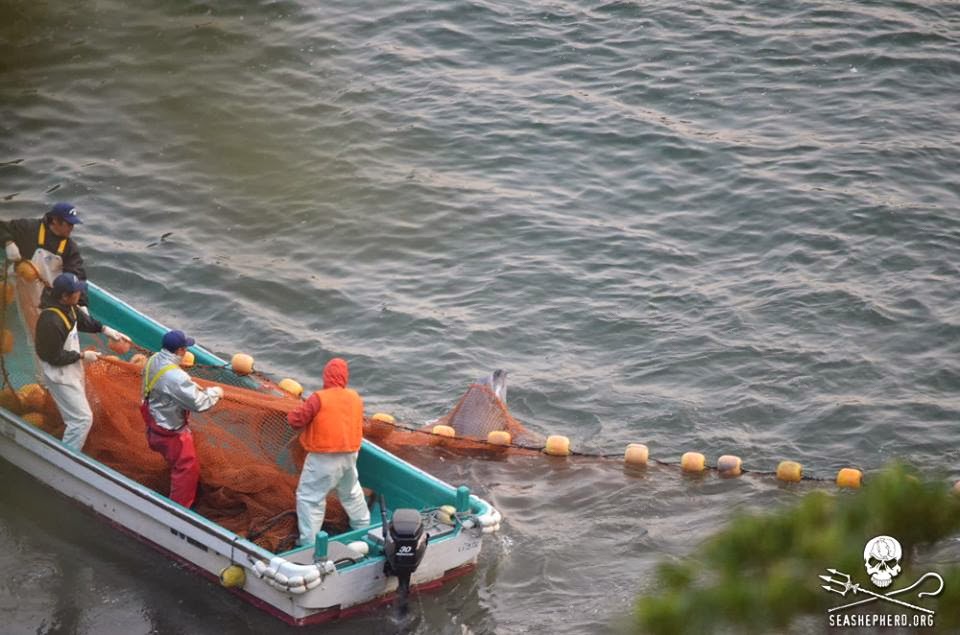
One of the poor dolphins was seen trying to escape death.  He swam at the net becoming trapped in it after he tore the net from trying so HARD to get away and escape.  Sadly, the hole was not large enough for the dolphin to break completely through and make his escape.  A skiff of killers saw the dolphin, and went to remove him from the net so they could kill him later.  After removing the dolphin, the killers ran him over with their skiff as they moved away.

One dolphin's last attempt to escape death breaking through the net,
 but too weak to make it through, the killers free it and run it over with skiff
Exhausted bottlenose dolphin looks his killer in the eye.
Bottlenose dolphins are naturally friendly to mankind,
why are a few "men" so unkind to the dolphins?
The Cove was now starting to turn a light red as the blood of the first slaughtered dolphins bled into the water.  The killers use wood dowels to plug the wounds made from stabbing the dolphins in their blowholes.  The killers do this to try and prevent the dolphin's blood from staining The Cove water - a PR move that fails.  The sheer quality of blood that is shed, even after plugging the wounds, still turns The Cove red.....

The Red Cove
The slaughtered bottlenose dolphin's blood flows out from under
the tarps where the dolphins are killed  
Dolphins are seen swimming in the blood of their relatives

The killers callously run the dolphins over with their skiffs, they make no effort to avoid the trapped dolphins as they go about their terrible work.  The dolphins are often injured by the skiff's propeller. 


The killers run their skiff over the dolphins
The killers make no effort to avoid injuring the dolphins with the skiffs propellers
The SSCG's camera found a weaken dolphin, barely able to keep it's head above water, some killers in a skiff spotted it too and moved closer.  A diver caught the starved dolphin, took a rope that is fixed to the skiff and put the loop of the rope around the poor dolphin's flukes.  The killers in the skiff then dragged the dolphin backwards by it's tail, which forces the dolphin's head underwater where  it cannot breath.  The killer dragged the dolphin tail first, under the tarps where it was slaughtered. 

Dolphins were too weak to fight back.
The killers kill the dolphins by taking the rope attached to the skiff, that has dragged the dolphin tail first, underneath the tarps which hides the killer's activity.  A waiting killer on the shore takes the rope from the killer in the skiff, and fastens the rope's other looped end to a post in the sand.  That anchors the dolphin so it cannot get away from the killer while he murders the dolphin. The killer takes a short spear called a "pith" ("verb, used with an object, meaning to destroy the spinal cord or brain of" ) and stabs the victim dolphin through his blowhole repeatedly to try and sever the dolphin's spinal cord.

Pith with wood dowel or plug
It must be terribly painful to be tied up and stabbed over and over again into the sensitive blowhole and not be able to get away.  When the killer decides he has severed the dolphin's spine, he takes a wood dowel and plugs the blowhole (now a wound) to keep the dolphin from bleeding too much and staining The Cove red.  The dolphin perhaps with his spine severed, perhaps not, bleeds out anyway, and slowly suffocates from having his blowhole plugged.  He trashes with his tail tied to the shore, as he suffers and suffocates, his spasms are terrible as he slowly dies.  The Japanese government has stated that the slaughter is humane and bloodless, does this sound humane?  Watch the video below and see for yourself.


Warning the video above shows how the dolphins are killed in Taiji.  This was taken in January 2011 of the slaughter of what appears to be a small pod of white sided dolphins - the slaughter is ugly.  Because these dolphins are smaller, their bodies are piled into the boat rather than towed to the butcher house as larger bottlenose dolphins are.  Please be sure to read the text at the films end.  This video was made by AtlanticBlue.de  Thank you for your courage to witness this.

A dead dolphin is seen through the tarps.  The Cove water is Red

Two dead dolphins are seen through the tarps. 
Between 40 and 50 bottlenose dolphins were slaughtered
A terrible death being stabbed to death after 5 days of starvation and trauma
While the killers were slaughtering dolphins, they found a "pretty" dolphin that they missed!  They forced her into a sling and took her out of The Cove and to the Taiji Harbor pens for a life as a show dolphin.  That poor dolphin swam in the blood of her murdered family and friends and heard them thrash and call out as they were slaughtered.  A trained show dolphin is worth more than $100,000, as meat, only $500 and nothing if released into the ocean and freedom.  From the killers point of view it makes more sense to keep dolphins for captivity ($$$$$) or meat ($): GREED trumps humanity.

After a little over 2 hours, a skiff leaves towing the bodies of the dead or almost dead dolphins, past their still living family and friends.   The skiff with killers, have draped the dolphin's dead bodies with tarps to try and hide the bodies from the witnesses at Taiji, the SSCG's cameras and the watching world.   But sometimes the wind blows (a divine wind?) and exposes the bodies which are seen by the witnesses and cameras.  Why do the killers try and hide their "Tradition" are they not proud of what they have done?  They take great pains to cover up what they do.  Remember, they also have tarps to cover up the examinations for captive selection and the murders they commit .  Why?


Killers hiding their culture and tradition covering the bodies of the
dead bottlenose dolphins as a skiff leaves The Cove
to take the slaughtered dolphins to the butcher house
to be cut up for meat and sold.

Then, a second skiff towing dead dolphins leaves The Cove.  The SSCG's Livestream broadcast showed The Cove's now very red water as the skiff moved away and towards the butcher house.

Banger boat transfers the bodies of the slaughtered bottlenose dolphins
to be received at the butcher house.  There the dolphins will be cut up as meat
Just past the 3rd hour, a 3rd skiff left towing more dead bottlenose dolphins to the butcher house to be cut up and sold as meat to Japanese people.  Why would the Japanese eat friendly, beautiful dolphins?  Especially when dolphin's meat has high levels of mercury because it is a top predator.  Their bodies absorb mercury from all fish they eat, and over time it collects in the tissues, so it does not make good sense to eat food that is toxic.

The Cove killing activity slowed down after the 3rd hour as the killers loaded up skiffs, numbers 4 and 5.  It was not known how many bodies each of the 5 skiffs were towing.  Afterwards it was reported that about 40 bottlenose dolphins had been slaughtered.

During the killer's break, the SSCG monitors talked about how especially hard this has been on these dolphins today.  The dolphins slaughtered today fought as best they could after being starved and traumatized the past 4 or 5 days.  But being so exhausted they were not able to fight as hard as other bottlenose pods that had been slaughtered in the past.  Just an awful thought for all these dolphins have been through.... we MUST help stop this terrible industry. The Japanese government allows the Taiji killers to take about 2 thousand dolphins and small whales (pilot whales which are actually members of the dolphin family) every year from September to March.  These so called "traditional" dolphin drives have only been happening for the past 40 years or so - not a long tradition.  It would have been too expensive in fuel to look for dolphins at sea and drive them back to shore, it is only because of the market for selling dolphins at very high prices for the huge entertainment industy that the drives have happened like this.  These drives to hunt dolphins have paid for lots of expensive equipment for the killers.

Cove Guardians bear witness to 40 dolphins being slaughtered.

The SSCG's showed via their Livestream, how the dolphins are transferred from the skiffs to the bigger banger boats which take the bodies to the butcher house.  The banger boats tow the dolphins dead bodies on the side of the boat that faces away from shore most of the time, to keep witnesses from seeing the bodies.  They also have a metal structure attached to one side of the boat on which to drape the blue tarps to cover the bodies.  The killers really don't want anyone to see what they are doing - such a proud tradition!

A remaining pod was later driven back out to sea
The remaining bottlenose dolphins still alive after all the horror they have been through, and just witnessed, were huddled together in the netted off area.  These poor dolphins were still waiting their fate and would become agitated every time they heard the skiffs coming closer to them, as the killers towed the bodies of their pod mates past them.  The skiff's motors herald the possibility of more torture.

Hungry, frightened and tired; these dolphins had to hear their families be slaughtered
 and had to swim in their blood. Nothing humane about this
After the killers enjoyed their lunch they finally released the remaining bottlenose dolphins who managed to survive the grueling 5 days.  Saying that the killers released the few surviving members of the original 250+ dolphins is a nice way of saying that the killers were in fact, driving them hard back out to sea with several banger boats chasing them.  The exhausted, starving, perhaps injured dolphins swam as fast as they could to escape the terrible killers and cove.  Even so, a few distraught dolphins were seen trying to swim back to The Cove to look for their missing family members, the ones that were taken from them either for dolphin shows or slaughtered.

Pod being driven back out to sea after 5 days of starvation and trauma,
some may not survive the killers treatment.  But the important thing to the
killers, is that those deaths won't be counted against their quota!


The killers took their time letting the survivors go.  It seemed like the killers wanted the dolphins to suffer for a little more time while the killers took their lunch break - no going hungry for the killers.  They seemed to deliberately do that to further torture the starving, traumatized dolphins - and show contempt for everyone watching their cruel industry. 

A juvenile Bottlenose barely surfaces during drive out.
The chances of survival are slim after 5 tormenting days in the cove.
Some or many of the released bottlenose dolphins may not survive the 5 days of starvation, dehydration, injuries and the traumas of being trapped, manhandled during the selection process and having their family members stolen from them.  Some are babies and juveniles too small to be worth it to slaughter (be counted against the killers quota) or too young for captivity and will starve without their mothers to provide milk and nurture.  Angel Shoujo was the first to be taken from her mother's side, where is her mother?  Did she pass captive selection? Was she slaughtered?  Was she one of the dolphins released?  Was she one of the dolphins who lingered after being chased back out to sea, looking for their missing loved ones?

The albino calf, later named Angel Shoujo, swimming with  her mother in The Cove
 from Jan 17th 2014 Dolphin Hunt Drive in Taiji
The next day Angel Shoujo was the first dolphin taken during the captive selection,
she was taken from her mother who was not able to protect her from the killers.

The drive out is just as traumatic as the drive in.
Some dolphins linger to find family.
Tomorrow it all begins again.  
The killers will go out in their banger boats to hunt for more dolphins to drive into The Cove.  The season still has more than two more months left and more money for the killers to make.  The killers are allowed to practice their horrible drive hunts from September to March.  And they will every year until enough people take action to help all dolphins and whales.

Update 1-25-14:  SSCG report "2-3 captive Bottlenose dolphins found floating dead in Taiji harbor pens."  These dolphins were captives from the 3rd day of captive selection and did not survive their first days of captivity after the stress of the 5 days of the 250+ bottlenose dolphin drive.  Their bodies were taken to the butcher house to be sold as meat.  More photos.

"2-3 captive Bottlenose dolphins found floating dead in Taiji harbor pens."

Please help, spread the word to your family and friends, sign petitions, express your views on media sites whenever there is a story and most of all Do Not Buy a Ticket to Any Places that have Captive Cetaceans or Swim with Dolphin Programs.  When you take away the Taiji' killer's market, you take away the money they get from selling dolphins and other cetaceans.  Please be a voice for dolphins, they need our help.

~ Kindness for Animals


See and find out more about this incredibly sad day:
  • Sea Shepard Cove Guardian PHOTOS of this last awful day - as hard as it is to read and see the photos and video, the SSCG have been witnessing every day in person as it happens.  I don't think I can fully imagine how hard that must be.  Thank you Brave and Dedicated Cove Guardians.
  • Ric O'Barry's Dolphin Project  PHOTOS of the awful day for the remaining members of the original 250+ bottlenose dolphin family.  Thank you Brave and Dedicated Dolphin Project Team.
Please read more about this tragic story of the 250+ dolphin pod with a baby albino dolphin that happened over 5 days:
Day 1 - Dolphin Drive Captures 250+ Dolphins Plus Baby Albino
Day 2 - First Day of Captive Selection:
Day 2 - Baby Albino Dolphin, Angel, is Taken First into Captivity
Day 3 - Horrific Second Day of Captive Selection
Day 4 - 3rd Day of Captive Selection
Day 5 - This is this post: The slaughter of 40 of the remaining dolphins who have survived so far and release and drive back out to sea of the exhausted, injured, traumatized and starving dolphins.

Very good report from Reuters about this terrible January day in Taiji from Reuters Videos